For decades, technology has forced us to adapt to machines.
- We learned how to type search queries into Google.
- We learned how to navigate websites.
- We learned how to communicate with software through menus, forms, and commands.
Multimodal AI changes that relationship entirely.
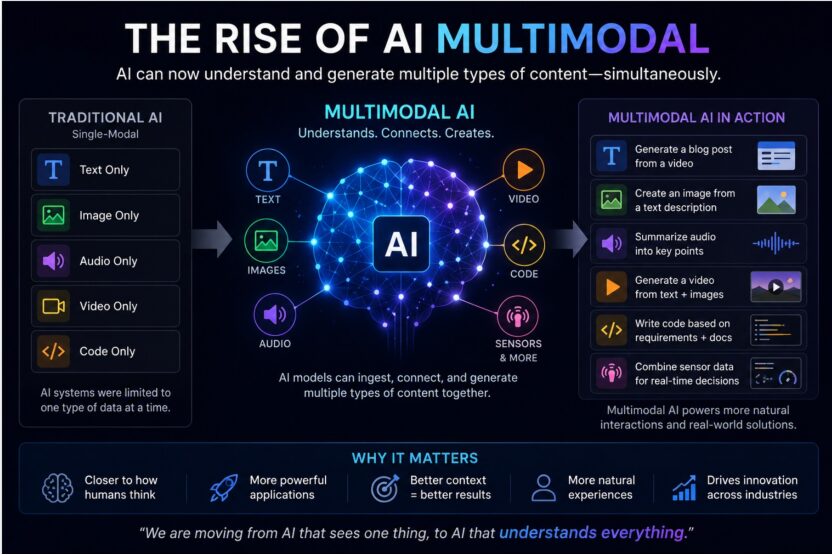
For the first time, technology is beginning to understand information more like humans do—through a combination of text, images, voice, video, documents, code, and context.
We are moving from AI that sees one thing to AI that understands many things at once. And that changes everything. From Single-Modality to Multimodal Intelligence
Traditional AI systems were designed to process one type of information at a time.
- A text model processed text.
- An image model processed images.
- A speech model processed audio.
Each system lived in its own silo.
Today’s multimodal systems—including ChatGPT, Gemini, Claude, and emerging AI platforms—can analyze and generate multiple forms of content simultaneously.
They can:
- Analyze a chart and explain it
- Review a website and identify improvements
- Generate images from text
- Create videos from images and scripts
- Summarize audio recordings
- Interpret documents, spreadsheets, and presentations
- Understand context across multiple content formats
The result is AI that more closely mirrors how people process information.
Why This Matters for Business. Many organizations still think of AI as a content-generation tool. That perspective dramatically understates what is happening.
Multimodal AI is becoming a business intelligence layer that sits on top of virtually every digital interaction.
It doesn’t simply create content. It connects information. It understands relationships. It synthesizes insights. It identifies opportunities.
And increasingly, it helps make decisions.
The organizations that learn to leverage this capability will gain significant advantages in speed, innovation, personalization, and customer understanding.
The New Reality: AI Is Becoming the First Point of Discovery. Perhaps the most important implication of multimodal AI is how people discover information. Consumers are increasingly asking AI platforms for recommendations, summaries, comparisons, and guidance before ever visiting a website.
Instead of searching:
“Best boarding school for ADHD students.”
They ask:
“What schools are best for students who need individualized academic support?”
Instead of searching:
“Best CRM productivity tool.”
They ask:
“What Salesforce solution can help sales teams manage calls, tasks, and follow-ups more effectively?”
The answers are no longer determined solely by traditional search rankings. They are increasingly influenced by how AI understands a brand, a company, a product, and its authority within a category. This represents one of the most significant shifts in digital visibility since the rise of search engines.
The Emergence of AI Visibility
At Spiderweb Studio, we have been exploring a simple but increasingly important question:
Does AI know who you are? Not just Google.
- ChatGPT.
- Gemini.
- Perplexity.
- Claude.
The next generation of AI-powered discovery engines.
Many companies have invested heavily in websites, SEO, content marketing, and social media. Yet they have little understanding of how AI systems interpret their brand or whether they appear in AI-generated recommendations.
The challenge is no longer simply ranking. The challenge is being understood.
This is why we have been developing AI Visibility Intelligence initiatives that help organizations understand how they are represented across emerging AI ecosystems and where opportunities exist to strengthen their authority and discoverability.
What Comes Next…
The rise of multimodal AI is only the beginning.
The next phase will include:
- AI agents that perform tasks autonomously
- Personalized AI advisors
- Real-time multimodal collaboration
- AI-powered business intelligence systems
- Digital experiences that adapt dynamically to user needs
Organizations that prepare today will be better positioned to thrive as these capabilities mature.
Final Thought
The most important shift is not that AI can now generate text, images, video, or code. The real shift is that AI is beginning to understand relationships between all of them.
That evolution moves us closer to systems that can reason, assist, and collaborate in ways that feel increasingly natural. The future will not belong to organizations that simply use AI.
It will belong to organizations that understand how AI understands them.