Most conversations about Artificial Intelligence focus on productivity.
- How many hours can AI save?
- How much content can it generate?
- How much more efficient can organizations become?
- Those are important questions.
But they miss the larger story. The real significance of AI is not that it helps us work faster. It’s that it is beginning to reshape how organizations think, create, and build.
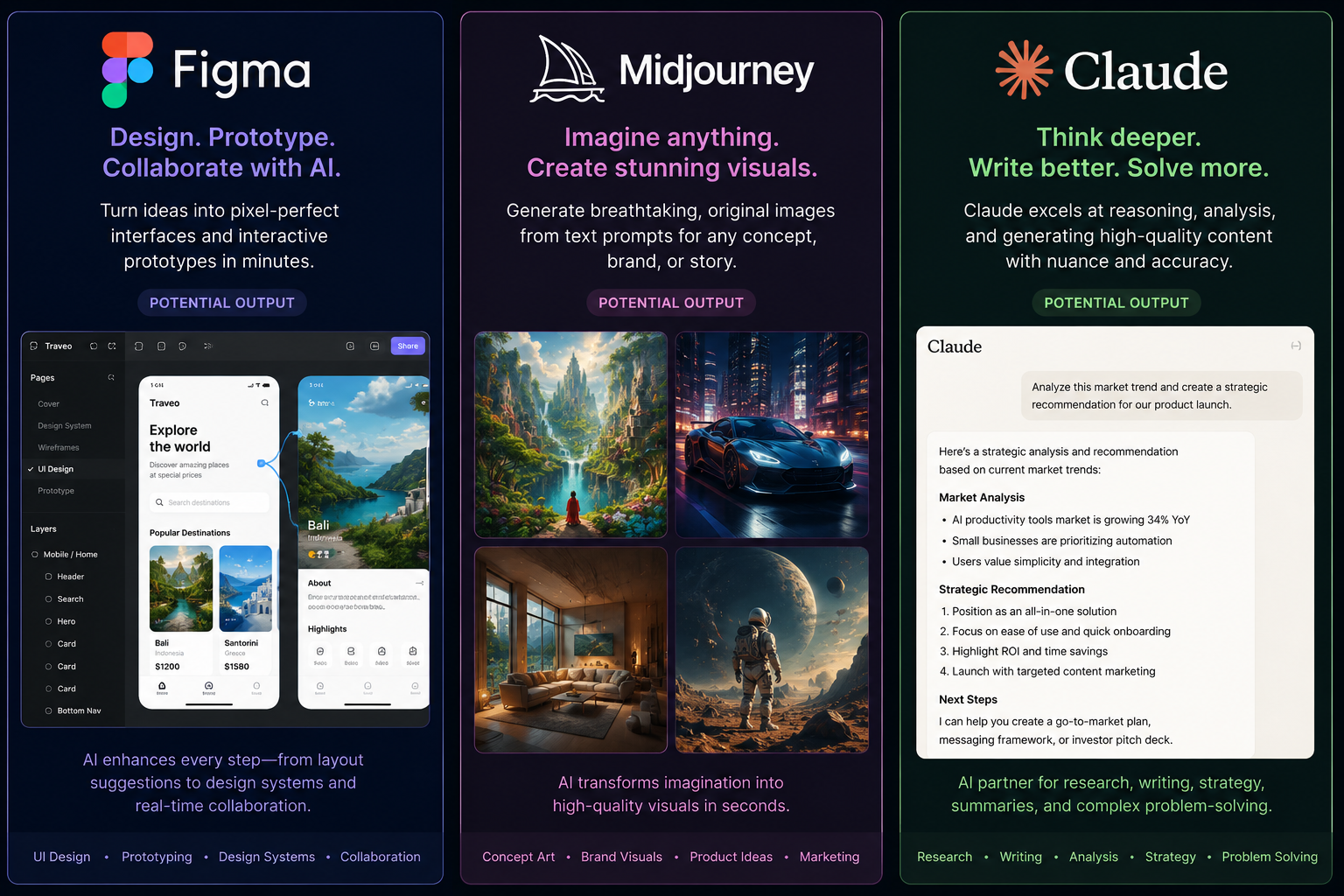
Three platforms in particular provide an early glimpse into what the future may look like:
- Claude.
- MidJourney.
- Figma.
At first glance, they appear to solve very different problems.
- One helps us think.
- One helps us create.
- One helps us build.
Together, they reveal something much larger. They represent the convergence of intelligence, creativity, and execution. And that convergence may fundamentally change how organizations operate.
Claude: The Rise of Strategic Intelligence
For decades, business leaders relied on analysts, consultants, researchers, and strategists to gather information and provide recommendations. Claude represents the beginning of something different.
It acts as a strategic thinking partner capable of:
- Synthesizing complex information
- Evaluating alternatives
- Identifying risks
- Generating recommendations
- Supporting decision-making
The real breakthrough is not content generation, it is reasoning. As AI continues to improve, organizations may increasingly rely on intelligent systems to support strategic planning, market analysis, product development, and operational decision-making.
Claude provides a glimpse of that future.
MidJourney: The Democratization of Creativity
Historically, creating high-quality visual content required specialized skills, significant budgets, and long production cycles. MidJourney changed that equation.
A single individual can now create:
- Advertising concepts
- Product visualizations
- Brand campaigns
- Storyboards
- Creative explorations
in minutes rather than weeks. More importantly, MidJourney is changing who can participate in the creative process. Ideas can now be visualized almost instantly. The distance between imagination and execution continues to shrink.
This represents a fundamental shift in how organizations innovate.
Figma: The Future of Building
If Claude helps us think and MidJourney helps us imagine, Figma helps us build. The platform is increasingly becoming a collaborative environment where teams can:
- Design products
- Prototype experiences
- Test concepts
- Gather feedback
- Iterate rapidly
With AI integrated directly into workflows, product development cycles are accelerating dramatically. The ability to move from concept to prototype to implementation has never been faster. This is not simply a design transformation. It is an innovation transformation.
What Happens When They Converge?
This is where things become interesting. Today, these platforms operate independently. Tomorrow, they may function as a single ecosystem.
Imagine:
- Claude identifies a market opportunity.
- MidJourney generates concepts and visual assets.
- Figma builds the prototype.
All within a connected workflow.
What once required multiple departments, agencies, consultants, and months of effort could increasingly be accomplished by small, highly skilled teams supported by AI.
The future organization may not be defined by size.
It may be defined by adaptability.
Three Bigger Changes Coming Next
Many organizations believe they are already experiencing the AI revolution. In reality, we may only be seeing the beginning.
1. AI Agents Will Replace Applications
Instead of opening separate tools, users will work with AI agents that orchestrate entire workflows automatically.
The focus will shift from software to outcomes.
2. Personalized Intelligence Will Replace Generic Platforms
Organizations will develop proprietary AI systems trained on their own knowledge, processes, customers, and competitive environments.
Every business will eventually have its own intelligence layer.
3. Continuous Innovation Will Become the Norm
Product development, marketing campaigns, customer experiences, and business strategies will be created, tested, refined, and launched at unprecedented speed.
Innovation will no longer be periodic.
It will become continuous.
Final Thought
Claude, MidJourney, and Figma are not simply software platforms.
They are early indicators of a larger transformation taking place across every industry.
- One teaches machines to reason.
- One enables machines to create.
- One helps organizations build.
Together, they offer a glimpse into a future where intelligence, creativity, and execution converge into a new operating system for business.
The real disruption is not that AI can create content.
The real disruption is that AI is beginning to transform how organizations think, innovate, and compete.